9 Causes of Plant Propagation Failure and the Tools Every Grower Needs
- hydroponicstown001
- Jan 9
- 4 min read
Plant propagation is the backbone of successful gardening, nursery production, and commercial agriculture. Whether you are growing ornamental plants, vegetables, herbs, or fruit crops, propagation determines plant quality, uniformity, survival rate, and long-term productivity. While propagation may appear simple on the surface, it is one of the most technically sensitive stages of plant growth.
Many growers—ranging from beginners to experienced professionals—experience repeated propagation failures without fully understanding the underlying causes. These failures can result in wasted time, increased costs, inconsistent plant quality, and reduced yields. Most propagation problems arise from a combination of environmental imbalance, poor technique, improper tools, and inadequate post-rooting care.
This blog explores the nine most common causes of plant propagation failure and outlines the essential tools every grower needs to establish a reliable, efficient, and high-success propagation system.
Table of Contents
|
What Is Plant Propagation and Why It Matters
Plant propagation is the process of producing new plants from seeds, cuttings, divisions, or other vegetative parts of an existing plant. While seed propagation is widely used, vegetative propagation—such as stem cuttings, leaf cuttings, root cuttings, and layering—is preferred in many settings because it produces genetically identical plants with predictable traits.
Propagation plays a critical role in:
Maintaining consistent plant size, shape, and yield
Preserving desirable genetic traits
Reducing dependence on costly seeds or imported plant stock
Shortening production cycles
Supporting large-scale nursery and greenhouse operations
When propagation fails, growers face delays, plant losses, labor inefficiencies, and higher operational costs. Understanding why failures occur allows growers to make informed decisions and improve overall plant health from the very beginning.
9 Common Causes of Plant Propagation Failure
Understanding these key issues helps growers prevent early plant losses and achieve higher propagation success.
Causeof Propagation Failure | Primary Problem | Effect on Plant Growth | Prevention / Best Practice |
Poor Cutting Selection | Weak, diseased, or flowering parent plants | Low rooting success and early cutting death | Select healthy, pest-free, vegetative parent plants |
Incorrect Moisture Management | Overwatering or underwatering | Stem rot, damping-off, dehydration | Maintain evenly moist, well-drained media |
Inadequate Light Conditions | Too little or too much light | Weak growth, leaf drop, delayed rooting | Provide indirect, consistent grow light |
Temperature Instability | Fluctuating or extreme temperatures | Stress, slow root initiation | Maintain stable root-zone temperatures (70–80°F) |
Improper Growing Media | Dense or compacted substrates | Poor aeration and root suffocation | Use propagation-specific, well-aerated media |
Poor Sanitation Practices | Dirty tools, trays, or containers | Fungal and bacterial infections | Sterilize tools and containers before use |
No or Incorrect Rooting Hormone | Lack of root stimulation | Slow or uneven root development | Apply appropriate rooting hormone correctly |
Inadequate Humidity Control | Dry air or excessive moisture | Wilting, mold growth, failed cuttings | Maintain 70–90% humidity using domes or misting |
Improper Aftercare & Transplanting | Early transplant or harsh exposure | Transplant shock and plant loss | Harden off cuttings gradually before transplant |
Essential Tools Every Grower Needs for Successful Propagation
Using the right tools allows growers to control environmental variables and significantly improve propagation success rates.
Propagation Trays and Cell Inserts
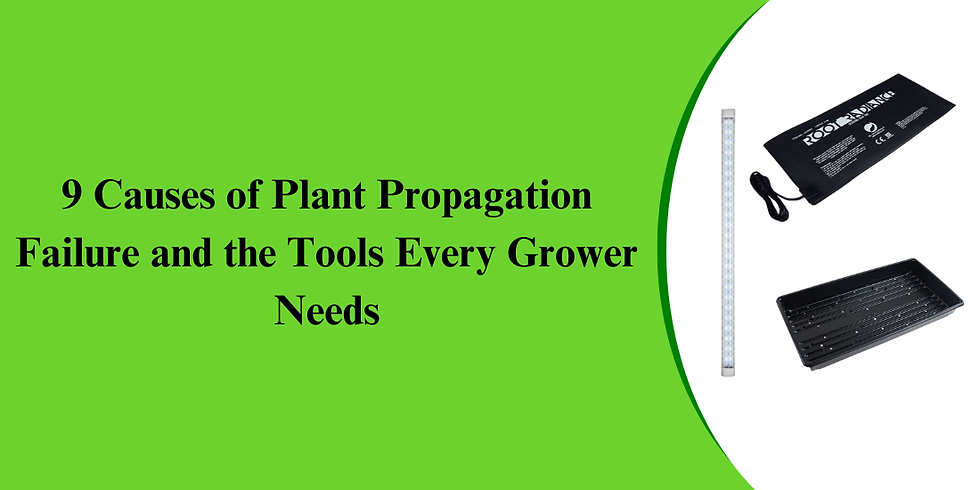
Designed to promote proper drainage and airflow, propagation trays support uniform moisture distribution and healthy root development.
High-Quality Growing Media
Propagation-specific media such as coco coir, peat blends, perlite, and vermiculite provide ideal moisture retention and aeration.
Sharp, Sterilized Cutting Tools
Clean and sharp pruners, knives, or scalpels minimize tissue damage and reduce disease risk.
Rooting Hormones
Available in powder, gel, or liquid forms, rooting hormones increase rooting speed and consistency across batches.
Humidity Domes or Automated Misting Systems
These tools help maintain optimal humidity levels, reducing water stress during early stages.
LED Grow Lights
Energy-efficient LED grow lights provide consistent light intensity without overheating delicate cuttings.
Heat Mats
Propagation heat mats maintain optimal root-zone temperatures, especially in cooler growing environments.
Precision Watering Tools
Fine mist sprayers and controlled watering systems prevent overwatering and physical damage to cuttings.
Monitoring and Labeling Tools
Thermometers, hygrometers, and plant labels help track environmental conditions and identify issues early.
Best Practices to Maximize Propagation Success
In addition to using proper tools, growers should adopt proven propagation techniques:
Select healthy, pest-free parent plants
Strong parent plants provide the energy and genetic strength needed for fast root initiation and healthy new growth. Avoid using stressed or diseased stock.
Maintain stable temperature and humidity levels
Consistent warmth and high humidity reduce stress on cuttings and promote faster, more uniform root development.
Use sterile tools and clean workspaces
Clean tools prevent the spread of fungal and bacterial infections that can quickly destroy young cuttings.
Match light intensity to plant species
Provide bright, indirect light to support photosynthesis without causing dehydration or leaf burn in tender cuttings.
Introduce nutrients gradually after rooting
Young roots are sensitive; start with diluted nutrients to encourage growth without overwhelming developing plants.
Harden off rooted cuttings before transplanting
Gradually expose plants to normal light, airflow, and temperature to prevent transplant shock and improve survival.
Consistency, observation, and timely intervention are essential for long-term success.
Conclusion: Building a Strong Foundation for Healthy Plant Growth
Plant propagation is both a science and a skill that requires attention to detail, environmental control, and proper technique. While failures are common, they are often preventable with the right knowledge and tools. By understanding the nine primary causes of propagation failure, growers can identify weaknesses in their systems and implement corrective measures.
Investing in essential propagation tools—such as quality growing media, humidity control systems, rooting hormones, proper lighting, and temperature management—creates an optimal environment for root development. When combined with good sanitation and careful aftercare, these practices lead to healthier plants, higher survival rates, and more predictable outcomes.
Ultimately, successful propagation lays the groundwork for productive gardens, profitable nurseries, and sustainable agricultural systems.
FAQs
Why do plant cuttings rot before roots form?
Rot usually occurs due to excess moisture, poor drainage, lack of oxygen, or contaminated tools and growing media.
Are rooting hormones necessary for all plants?
Not all plants require rooting hormones, but many benefit from faster and more consistent root development when hormones are used.
What humidity level is ideal for propagation?
Most cuttings perform best at humidity levels between 70% and 90%, depending on plant species and environmental conditions.
How long should plants remain in propagation trays?
Plants should stay in propagation trays until they develop strong, well-branched roots capable of supporting growth after transplanting.


Comments